When it rains…

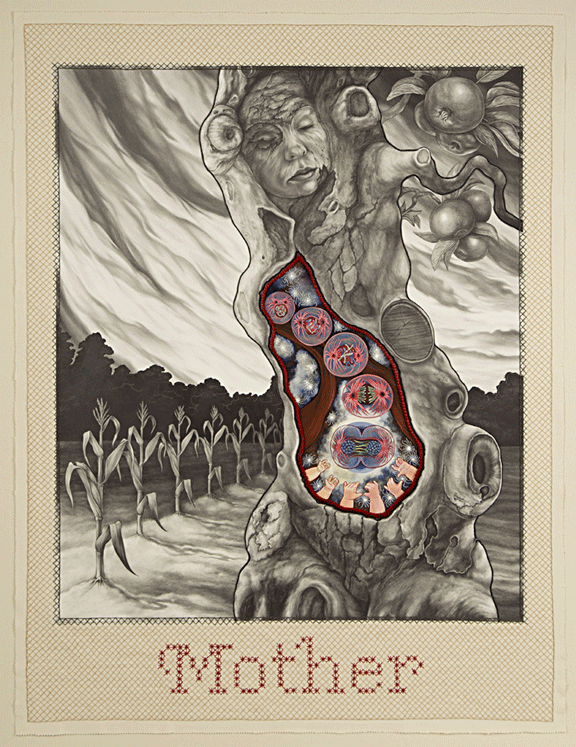
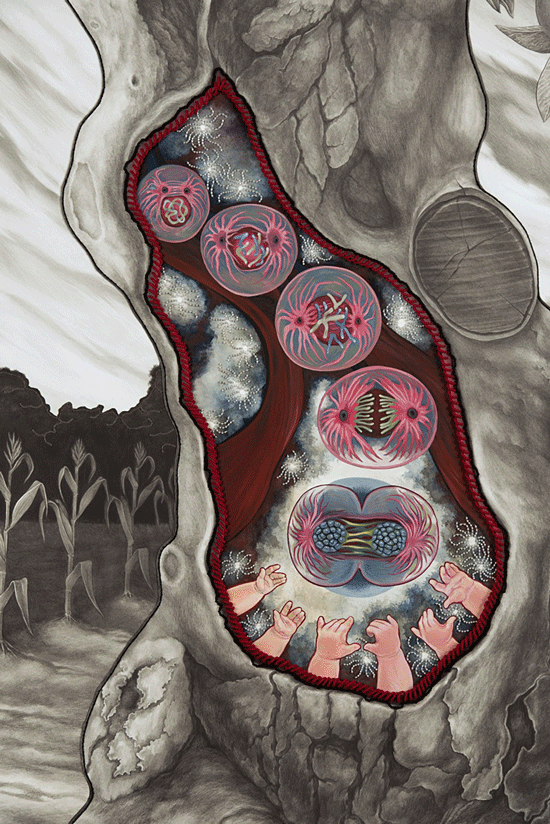
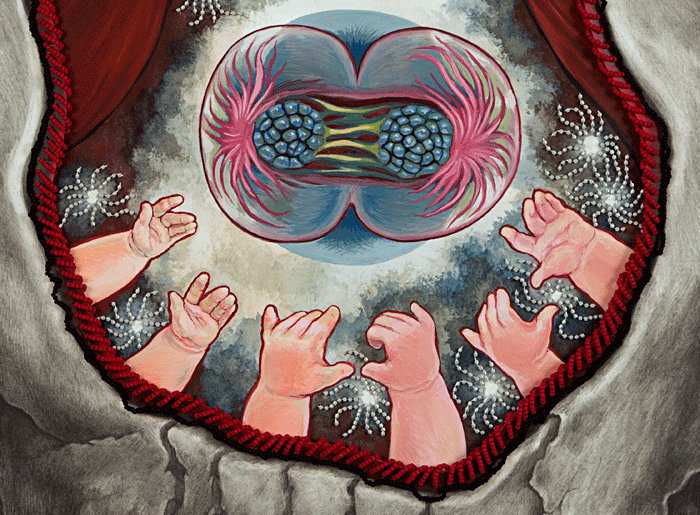
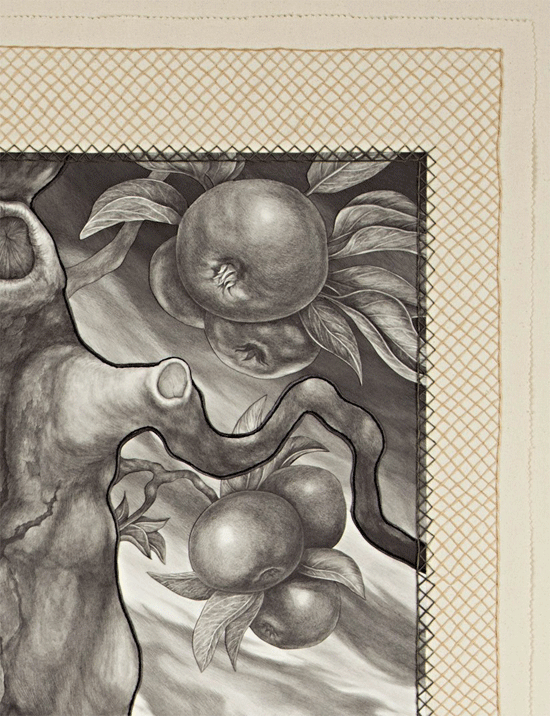
"And then we devoured our young"

A Happy New Year to all!

While my primary goal this month is to barracade myself in the studio so I can finish the current drawing, I do have to venture out…I am starting the new year off with quite a few exhibitions up and down the East Coast; two in New Jersey, two in Alexandria, Virginia, and one in Jacksonville Florida.  Please drop by if you are near any of the shows:

Fears and Phobias    Target Gallery at the Torpedo Factory, Alexandria, Virginia

January 12 – February 19

Opening Reception: Thursday, January 12th  6 – 8 PM

“A timely exhibit that explores the theme of fears and phobias. Some of the work is introspective and personal, while others express these issues in a larger social context. ”  (Artwork by fellow South Orange artist Jennifer Takahashi is also featured in this exhibit).

Fourteen (mixing memory and desire)


   From What I Remember, From What I Forget   

   Principle Gallery, Alexandria, Virginia

   Opening Reception: Friday, January 20th   6:30 – 9 PM

   Curated by the Broadstreet Studio artists, this will be a beautiful show in a beautiful space!


   Art Connections 8  

   The George Segal Gallery, Montclair State University, Montclair, New Jersey

   January 17 – February 18, 2012

   Opening Reception: Sunday, January 22nd   2 – 5 PM


   Alice: Into the Looking Glass

   Noyes Museum of Art, Oceanville, New Jersey

   February 3 – May 20, 2012

   Mad Hatter Party & Opening Reception: Friday, February 3rd   5 – 8 PM

  “A diverse selection of works range from illustrations based closely on Carroll’s text,

   to works which allude more subtly to the original story, offering new and sometimes challenging

   interpretations.  Imagery relates to the multitude of themes found in Carroll’s stories.”


And, last but not least…(what is it with me and Alice?)

Drawing Muchness    

University of North Florida Gallery of Art, Jacksonville, Florida

February 3 – March 2

Closing Reception: March 1, 2012


“The Dormouse had closed its eyes by this time, and was going off into a doze; but, on being pinched by the Hatter, it woke up again with a little shriek, and went on: `–that begins with an M, such as mouse-traps, and the moon, and memory, and muchness– you know you say things are “much of a muchness”–did you ever see such a thing as a drawing of a muchness?’”

Lewis Carroll, Alice in Wonderland.

BANG TIME!

It’s time for BANG* – the annual small works show at 1978 Maplewood Arts Center
The artsy show with the bawdy name is back! 
Saturday & Sundays, December 3rd & 4th and 10th & 11th         
11 AM – 5 PM each day.
 
This year there are over 45 artists, hundreds of works of art – small and affordably priced for holiday giving. 
Or, even better, you can be just like Herb and Dorothy and start or embellish your own collection with artwork from local and regional artists. 

Little Acts of Courage

I have a few Strange Tales and encaustics on display, as well as prints of the large scale drawings. 

Some of my favorite pieces from local artists this year include Maya Bloom’s lovely jewelry made of seeds and pods, as well as her Beads of Peace necklaces:

Jo Bradney has prints and notecards of the pink donuts painting, Sugar Spiral (the original of which is also on display, and a painting that I adore and want, but I am just not sure about living with a work of art that makes me want to lick icing…)

Suzanne Henning has a great selection of embellished prints:

And, there is the local treasure, ceramicist/painter Phyllis Carlin…I have my eye on Stravinsky Immersed In The Creation of Spring:

Drop by, say hello, enjoy the hot mulled cider, and, better yet, avoid the mall and support local artists and 1978!

*Bawdy?  absolutely…and, just because someone complained several years ago and insisted on changing the name, I now refuse to – so BANG it is! 

Limitations

I found a rather timely little message in my fortune cookie this week:

Perhaps I find it so timely because I am not letting a little matter such as a size limitation get in my way: the current drawing in progress needed to be big, so it is big.  I will deal with the problem of framing a 4 x 6 foot drawing later…

Plus there is my upcoming project, the beginning of which is simultaneously in progress with the big drawing (well past the planning and sketching into the gathering and preparing materials stage).  This new project revolves around creating artwork with subject matter illicit enough that it gave me a momentary pause over whether or not I could post the completed artworks on my website (I will – with a little disclaimer, of course). 

I have had this new project on the backburner for nearly four years and then along came an exhibition opportunity that gloriously lifted my own self-imposed limitations, leaving me to wonder why I had set the idea aside in the first place.  Perhaps it is one of those curious things having to do with timing and waiting for the perfect moment for all of the separate parts to fall into place; regardless I could not be more energized about the new endeavor.  I know that I am being cryptic, but this little embryo of inspiration has moved out of the freezer and matured into the toddler stage, and yet it is still too delicate to discuss outside the studio.

And, speaking of limitations – in this case the limitations of media – I am still beading paper.  This paper is black Stonehenge – a gorgeous printmaking paper which has a surface that is ideal for pastel and colored pencil (for this drawing I have used graphite and silver colored pencil).  I reinforced the back of the paper with archival black linen tape (usually sold with the bookbinding materials) so the paper is tear-proof (hopefully) and I am currently beading away….here are some close up shots:

Still drawing…

Yep, still drawing….

The entire background is now pencilled...still more collaging, stitching and beading to go.

Actually, this photo was taken a month ago - the background is now covered in pencil. I am currently beading/stitching the collage elements. 

To keep this 4 x 6 foot drawing from being too overwhelming, I did a couple of little pieces over the past week to appease the Pre-Raphaelite, fairie, Arthur Rackham-loving side of my personality.  Frankly, I needed a break from the big one; I have found that too much time on one piece can make it hard to make objective decisions.  I started the drawings for these little ones a couple of months ago (mentally started them much earlier, as I spent most of the summer with one eye to the ground, gathering four-leaf clovers).

The first is The Luckiest Girl – encaustic, drawing, four-leaf clover on board:

and here is a detail:

and the second is as of yet untitled -encaustic, drawing, butterfly wings, pressed columbine:

and here is a detail:

detail of drawings, butterfly wings, columbine

Now…back to beading, stitching, beading…

“Counterparts” Fall Art Salon

Temporal Reverie, graphite and watercolor on Arches HP watercolor paper, 26 x 32 inches

I have four drawings on display in Alfa Art Gallery’s New Brunswick Art Salon “Counterparts”. 

From the gallery’s press release:

Counterparts” is an exhibition that highlights the collaboration of opposites. Contained in this collection of works is a variety of contrasting elements that complement each other:  representational with abstract pieces, conversations from past to present, narratives from experienced to imagined and styles that are dynamic and tranquil. Featuring Ellen Weisbord, Jamie Greenfield, Lisa Pressman, Nilufer Ozturk, Sarah Petruziello and Theodosia Tamborlane, this exhibition, varied in style and medium, demonstrates an extensive scope of aesthetic sensibility, where concept is executed into art from different viewpoints, and brings together an explosive showcase of cooperative diversity.

Opening Reception:     Friday, October 21st   6:30 – 10:30 PM

Exhibition Dates: October 21 – November 10, 2011

Alfa Art is located in New Brunswick, New Jersey.

Directions are here.

Cover Songs

Goya’s Cat – pencil and silver color pencil on black Stonehenge paper

I have a new appreciation for the paintings of Thomas Kinkade, and that is not a joke – I have been studying his work while recreating a Kinkade-style dreamy English cottage as part of my current large-scale drawing. I am not copying one of his paintings: although I am sure that legally I would be avoiding copyright infringement because the piece I am making would have used his work as a catalyst for only a section of a larger image.  In other words, visually quoting the kitsch idea of peace and tranquility to heighten the confrontation of the War Paint portraits, but I prefer to not even skirt the copyright issue.  My solution was to look at a lot of Kinkade’s paintings and use the clichéd sensibility of his work in order to recreate a syrupy and idyllic sense of the perfect home.  And, more pragmatically, to create a house that would be a better fit into my own composition. Originally, I was visualizing a Maxfield Parrish-style home, but the more I looked at Parrish’s work, the more I began to think that it was too refined, too artistically sophisticated; I needed something slightly more sentimental, slightly more ironic. The home has to feel like a fairytale and have the undercurrent of unattainable serenity. In the end, there seems to be this amalgamation of Kinkade, Parrish, and a bit of Thomas Hart Benton (who I do not associate with cliché, but I do love his magnificent roiling landscapes and clouds).

The more I look at Kinkade’s work (I have to confess that I bought one of those calendars), the more I realize he is not a half-bad painter; he certainly can paint an English garden replete with foxgloves and stone garden walls.  And, he is indeed the painter of light – lampposts, light coming through Tudor-style leaded-glass windows, clouds hovering over the soft glow of pink sunsets. He creates an implausibly unblemished, soft-edged beauty that looks great on nightlights, calendars, and machine-knitted throws; pleasant and unchallenging loveliness to decorate and accent the home – hence the reaction of distaste from a bevy of fine artists.

I do reference artists here and there, usually of the long-dead-European variety, to reference a concept or suggest a story, and occasionally I have copied to learn a technique. When I was in a freshman art history course, the graduate student teaching the class required the students to draw the Mona Lisa simply because most of the students could see and identify the painting, but very few of us had actually looked at the painting (I, for one, had never noticed her veil and the mountains in the background). The practice of observation and then rendering changes how one sees the work of other artists.  It is rather amusing that in the process of actually looking at Kinkade’s work, I have overcome the impression of its tackiness and have studied his painting style; again, not at all bad, particularly since he has well-developed range of value (keeping the paintings from appearing too fluffy) and he has a knack for the textures of landscape, trees, shrubs, and flowers.  Okay, so I do still long for meaning past the sugary and maudlin imagery – I have mentioned on more than one occasion that I would like to throw a slab of meat or a skeleton into one of his paintings just to give it a bit more edginess. But, I doubt that would please a public looking for imagery that brings comfort to the home or at the very least matches the sofa.

Truthfully, I am a little concerned that my attempt at recreating his sensibility will not have nearly the same syrupiness as an actual Kinkade, and thus it will lack the ironic edge – although I did draw a pretty fantastical cottage and garden, I am intrinsically unable to make something so soft and sentimental.

In this same drawing I am also recreating sections of Francisco Goya’s The Sleep of Reason, specifically the cats, the owls, and the bats.  This is another artwork that, just like the Mona Lisa, I could recognize immediately, and I had perceived it as a whole without thinking about the details, but as I started to break the separate elements apart, I realized that the image is rendered in a manner very close to cartoon-style illustration with animals that are inaccurate and almost whimsical. In Goya’s work, however, the overarching despondency and emotion obscures the less realistic elements. Goya was a master of mood, his body of work encompassing both a removed, objective eye for the details of war, as well as the imperfections of royalty, and more theatrical displays of the wickedness and evil of man, not to mention witches and the spiritual realm, but for the most part the temperament displayed in his paintings is that of an artist who was a direct and honest conveyer of human nature.  Although I have garnered a touch of appreciation for Kinkade’s painting style, it is Goya who I have grown to admire and love (even more than before) during this process – the inconsistencies, the flaws, and the raw emotion in his work is that of a true master.    

It is the process of recreating the style/imagery of other artists that has been most surprisingly transformative for me in this drawing. 

Back in the late nineties, when my husband was promoting an album by World Party, he was driving the musician Karl Wallinger (aka World Party) around to interviews, and Wallinger mentioned in a few of these that he had recorded a couple of Beatles songs note-for-note, just to break them down and to understand how the Beatles structured their songs:  the self-assigned task of breaking apart the songs he so admired taught him how to better construct his own songs. This idea really stuck with me.

More than just creating another cover song, the process of actually deconstructing, synthesizing, and reconstructing another’s work is not simply a venture into regurgitating the past.  Rather, it gives the artist the opportunity to internalize the canon, and to reflect over of the masters of his or her own media, discovering the imperfections and contradictions, and the enduring spirit of the artist’s work.   

Not to mention the chance of finding a sliver of appreciation for an artist that previously had been purely the subject of jest.

Some work-in-progress pictures…bad photos, of course…it is too troublesome to drag the unweildy 48 x 72 inch drawing board into better light and, until sprayed with fixative, the pencil is too refective:  

Those clouds are looking a bit more like the Thomas Hart Benton variety...

View of the cottage; this section around 20 x 30 inches

Work in Progress - War Paint portraits are in place - still more drawing, cutting, stitching, beading...

Oh yes, this could end up as one hot mess when it is done; there is a lot to resolve and hundreds of hours of drawing could be for naught.  But, I am taking it in stride; for me, there is no growth in art – or enjoyment for that matter – without the risk of failure.

Oh, and my favorite cover song: that would probably be Elliot Smith’s cover of the little George Harrison gem “Long, Long, Long“.

Zoom!

The new zoomify page on my website is up and running:

http://www.sarahpetruziello.com/zoom.html

This allows viewers with flash installed to click on an image and zoom in to see the detail

(woohoo!  look at the pencil marks! sooooooo much nicer than a jpeg…)

A big thank you to Jo Bradney, the fantastic website deviser/visionary (not to mention a darn fine painter of lusciously luminescent citrus). 

Surface and Perfection

I love the suggestion of surface on two-dimensional art; I love to see marks in drawings, I love visual and physical texture in painting, I love to see evidence of the movement of the artist’s hand across a work of art.  The first time I saw a Leonardo da Vinci drawing in person was at Windsor Castle in 1988: I marveled at his mark-making – layers and layers of lines that were the direct result of the movement of his hands. This drawing was from one of the sketchbooks, consisting of hatched lines exquisitely delineated because they were executed with pen and ink – the crisp brown ink lines slightly rising from the yellowed surface of the paper.  It is peculiar that I don’t quite remember what the drawing was of (it was definitely a figure), but the lines are so vivid in my mind.  Those lines were more edifying than the demonstrations from my freshman drawing classes: until that point I had only seen his work in art history texts where his sketches were reproduced as color plates (printed via offset-lithography with all those little half-tone dots that are not too unlike a jpeg as far as clarity).  Seeing the actual marks made by his hand was so illuminating because they were not softened and simplified into a perfect and pristine surface with the gloss of the textbook paper refining the image, rather they were the tangible and textured evidence of his movement and, more importantly, the evidence of his process of synthesizing and thinking about what he was seeing.

It is not that I mind a perfectly smooth or polished surface in a drawing or painting (so very lovely and seductive indeed) but as far as seeing how the artist thinks and moves, those marks made by brushes, pens and pencils are very telling; honest and revealing, a glimpse into the mind of the artist at the time of creation, not to mention a physical document of the artist’s movement.  There is energy captured in a mark, sometimes there is even struggle and hesitation. I have realized that this is probably why I am so fond of certain abstract expressionists, such as the late work of Kandinsky and both de Koonings (Elaine and Willem).  And, likewise why I am so fond of Andrew Wyeth – although on the other side of the style spectrum, he is another artist whose paintings when seen in person are so much more captivating than the image that is reproduced in books or texts: you can really study the linear movements on his surface – the pure energy and economy and skill of control that is contained within a hyper-realistic accuracy. 

Twenty years ago, I was striving for perfection on a surface – no flaws – even and pristine layers of smooth graphite.  At some point in the past 10 years, I found myself interacting with pencil and paper in a more instinctive way, and this transformation is not because I am working faster: quite the contrary, I have somehow slowed down, as it takes much longer to complete a drawing than it used to take.  But now that I do not concentrate on surface perfection, there are flaws on the surface, dents and impressions on the paper: some of these imperfections I can smooth out upon completion with a light coat of matte medium, but others are there for good.  This imperfection is not the same as craftsmanship, which is something that I have always been compelled to strive for – messiness distracts from the work itself, so presentation remains paramount with clean edges and the white of the paper neat.  Rather, this imperfection is the true physical impression that remains on the surface of an actively worked drawing.

I have found that it is liberating to approach the creation of art not as means to get to a final product, but rather to consider art a product resulting from the compulsion to make.  So, when I am drawing in the studio, I am not consciously aware of how the surface will appear.  The process of drawing is about the sensory contact of pencil on paper, and realizing that paper (as much as canvas or a sculptural medium) is a physical thing that can be torn, bent, cut, held, damaged, transformed and reassembled. More often than not, I am finding that I simply get lost in the back and forth action of drawing, erasing, drawing, erasing and gradually building up value. Now I am starting to have the desire to push the physical properties of the medium, too, such that more and more in my own drawings I want to do stitching, sewing, beading, and manipulation of the paper.

the planning ahead part: testing different beads, pencils, and acrylic mediums on black Stonehenge paper in preparation for the current large-scale drawing

This does not negate planning or consideration about what I am about to draw before I actually start working on a large sheet of paper; I am working in realism, so the structure of my drawings is planned and sketched ahead of time or during or after in some separate part of my brain, allowing the actual process of making to become looser, occasionally meticulous, yet not precious.

Maybe this instinctive letting go of surface perfection is my way of bucking what I fear is a trend towards visual homogenization: seeing so much digitally reproduced artwork on a flat screen monitor.  Maybe it is that smooth suggests to me Plexiglas and enamel and other surfaces of mass production.  I want earthy and tangible, I want a touchable, physical surface and the feel of the artist’s hand.

On that last thought of earthy and tangible, here is a link to the too-good-not-to-share posthumous video commentary of Lucian Freud’s painting ‘Standing by the Rags’ from the Guardian’s art critic Adrian Searle: “Freud didn’t so much have a career as a life”.  

In the next week or two: Thomas Kinkade, Goya, and detail photos of the drawing in progress.

jpegs

The web mistress (as she calls herself) who is otherwise known as Jo Bradney, fellow artist and the lady responsible for the way this website appears, has created a webpage for my site that will allow for zooming into the detail on my drawings.  I am immensely pleased that this is going to be up and running soon; I have a serious – and I mean serious – dislike of the clarity of these little jpegs online.

Overall, I am rather ambivalent about jpegs: they are unquestionably easier than slides – easier to arrange, edit, label, and store, not to mention the fact that digital is so much cheaper (it once cost a small fortune to make duplicate copies of slides).  I truly have no desire to go back to slides.  But, I am vexed by having to depend on jpegs for entering shows or to go along with proposals for exhibitions – they just don’t look quite right nor do they accurately reflect my artwork. Unlike slides, which, under normal viewing, were projected in their fully detailed glory onto a screen, digital images are confined to itty bitty little monitors, making my drawings appear as little book illustrations rather than the large-scale objects that they are.  Or, much worse, jpegs are displayed via LCD projectors onto screens so there is this overall pixelated quality to the image. I suppose that at the very least I should be happy enough that I am not trying to reproduce the depth and light of encaustic or the texture of impasto paintings digitally.

I am reminded of an interview I once heard with Neil Young around 20 years ago: he was complaining about the tinny sound of CDs as a result of the way the music is stored in a digital recording. Essentially, the pure sound of the musical information is simplified and broken down into digital bits, 0s and 1s. He compared it to an analog photograph versus a digital photograph – an analog photograph has all of the pure subtle transitions of light and value whereas the digital photograph abridges visual information into small squares of data.  The sound is on digital is not pure (and, if you have ever listened to an analog recording on a high quality vinyl record, played via a good pair of speakers, off a good turntable through a good amp, then you know what I mean – it makes an mp3 recording of music seem like you are listening through a tin can).

Which brings me to my true vexation with jpegs: since the level of resolution used for most applications or shows is so low, the information does not accurately portray the artwork, almost regardless of media, whether realist, abstract, or three-dimensional (although I suspect that jpegs might be fine for photographers or those working with digital media).  The concept is often clearly translated through a jpeg (the image is the image) and the values and colors may be correct, but the magic that is a true work of art is not reflected: the details, the marks, the movement, the surface, the scale, the light, and that enchanting thing that is transmitted from a work of art that has been touched by the artist.  A good slide, which normally had to be projected onto a screen (not on a little monitor), often came a whole lot closer to representing the essence of the artwork. 

It is interesting that for such a progressively more visual culture we are getting less and less of the intangible and magical power from the presence of an actual work of art, and more of a cursory impression of the idea and concept behind the artwork.  [Sigh] and then again, there is the not-to-be-ignored, fantastic ease of getting your work out there on the internet in this world of digital imagery at your fingertips.

So, can you guess what I will be doing over the next few weeks? Organizing my jpegs for applications that I am sending off in the mail. It does not escape me that nearly every show I have had was as a result of word-of-mouth or a curator seeing my work in person – rarely off these little reproductions.  But alas, there are some things I want to apply for that are only taking jpegs, so it is time to suck it up and send these jpegs off, because this is how things are done these days. 


a few of my encaustics (cut paper, graphite, butterfly wings, silver leaf) = totally flat little things when reproduced digitally...


August odds and ends

First on the list of odds and ends for August: I now have a twitter account and I just set up a public Facebook page for my artwork. Yes, I set these up just in time for everyone to switch to Google+. Seriously, I wanted to be able to tweet my blog posts and coordinate that with Facebook. Plus, since I have been reading my husband’s twitter feed to skim over the news article links, he suggested that I could get my own account.

Twitter is here: sarahpetruz

And, you can be a fan of my artwork on my new Facebook page (come on, be a fan!!!)

Of course, the rss feed is still over there on the right. That works, too.

Next up on odds and ends: my friend, fellow artist, and mentor Barbara Minch has started a blog on creativity - the artist’s idea factory - and you can now see her artwork on her new website.

And, to close out the list of odds and ends: several months ago I gave permission for one of my drawings to be used on the cover of the Turkish edition of Michael Pollan’s The Botany of Desire. The publisher did a wonderful job with the design (click here to see) - and beautifully integrated the image with the text (and the image works so well with the concept of the book itself). For those of you who knew about this from the beginning, I am happy to report that they did pay for the use of the image (I have not received a copy of the book, although they forwarded a high res pdf of the front and back cover). I know that a lot of artists get cheated by not getting compensation for their work when it is used outside of the US; sending digital files, only to discover that there is no reasonable legal recourse when payment is not made is a frustrating and belittling experience. In my case, I trusted they would pay, and fortunately they did. But, if anyone wants to start up an international visual art image broker available for all artists (in the style of Getty or Corbis, but with the unrestricted accessibility of an eBay, that would function in a PayPal manner – payment made by the client first, and then distributed to the artist when the files are uploaded) take my suggestion and please do. And, let me know when you get that started up – or, if one already exists, someone please let me know, because it is rather shady and unsure out there in copyright/compensation land for the individual artist.

I might actually end up in the black this year with art sales and such …not so bad after 17 years in the studio.  Next week’s blog…jpegs and my sanity.